How ATM Cameras Captured a Cloned Card User in 72 Hours
A Tampa Bay man was sentenced to five years in federal prison after purchasing six cloned debit cards on a darknet marketplace, withdrawing cash from four ATMs, and being identified through surveillan
Published: | Updated: November 23, 2026 | By: Derek Whitman | 14 min read
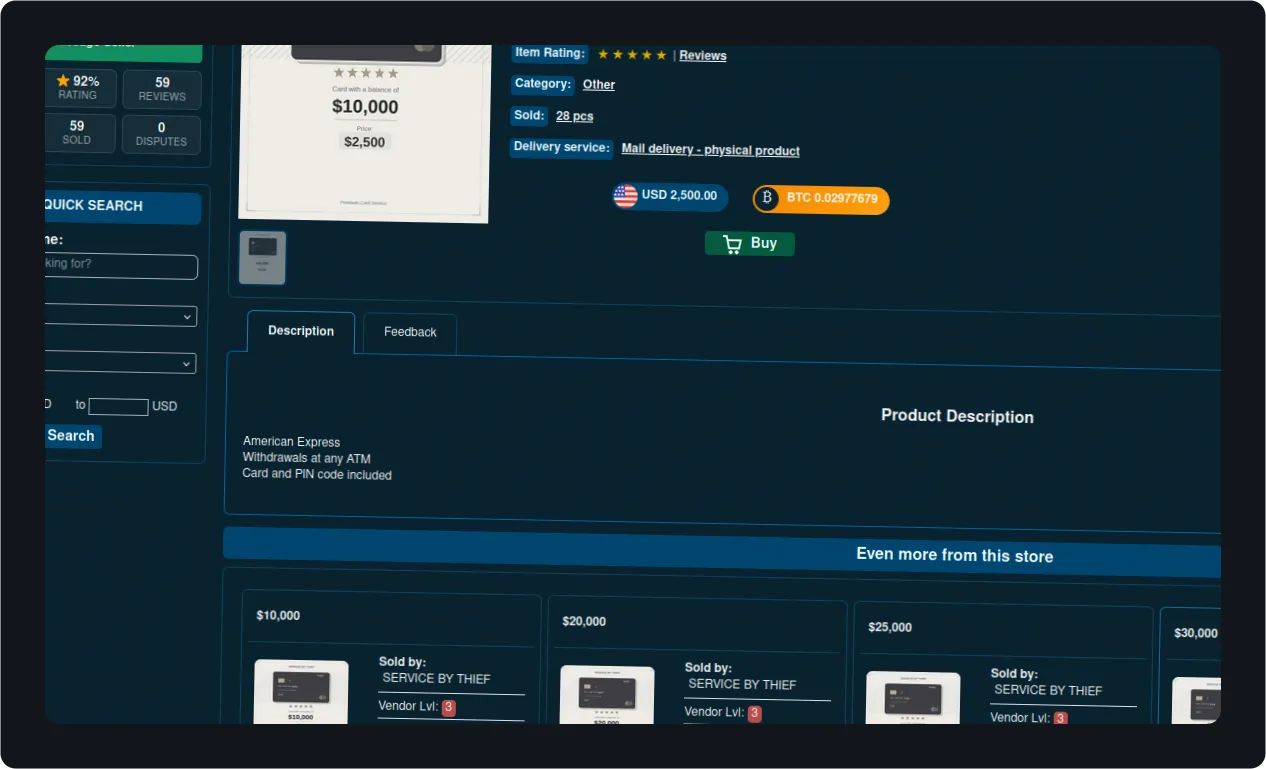
During November 2024, a Tampa Bay resident named Mark T., aged 34, thought he had found an effortless route to fast cash. He paid $480 worth of digital currency to purchase six counterfeit payment cards from a hidden online marketplace, each accompanied by stolen access codes. The magnetic strips contained information duplicated from legitimate bank accounts—common inventory within underground fraud networks. Across three visits to cash machines, Mark extracted $4,200. His fourth withdrawal ended the operation immediately.
This narrative is not a manual for obtaining illicit financial instruments. Instead, it explores how an individual who felt invisible was traced and arrested in 72 hours, why video surveillance at automated banking terminals proved more effective than conventional investigation methods, and how a chain of digital records—stretching from virtual currency accounts through federal agents—led to 60 months behind bars.
For anyone wondering how protective infrastructure operates in real circumstances, this episode shows where physical proof meets electronic investigation. It exposes precisely where assumed anonymity collapses and how contemporary fraud-prevention mechanisms work beyond public scrutiny, quietly safeguarding the financial system.
1. The Mechanics of the Carding Chain
What drives the underground economy in stolen banking credentials? The criminal workflow Mark participated in stands among the longest-running and most enduring varieties of digital fraud, unfolding across multiple coordinated phases.
Offenders initially acquire magnetic stripe information—track 1 and track 2 records—by deploying physical skimming hardware on cash machines, inserting shimmer tools into payment terminals, launching phishing campaigns, or buying dumps from darknet vendors. Consumers concerned about detection often ask about identifying tampered readers: visual examination for wobbly parts, unexpected additions, and side-by-side comparison with neighbouring machines provides the first line of defence. Electronic detection tools can spot irregularities, though most people depend on careful observation. Reviewing photographs of skimming hardware online builds familiarity with typical configurations. Defensive strategies—shielding the keypad during entry and preferring contactless transactions—reduce exposure to compromise.
After data collection, criminals encode the information onto blank plastic, embossing realistic details such as cardholder name, expiry date, and account number. When the PIN has been captured using a false keypad overlay or concealed surveillance camera, the purchaser obtains a fully operational tool for extracting funds. Withdrawal operations proceed rapidly, draining accounts ahead of detection and cardholder intervention, then converting stolen cash into digital currency via specialised kiosks or decentralised trading platforms.
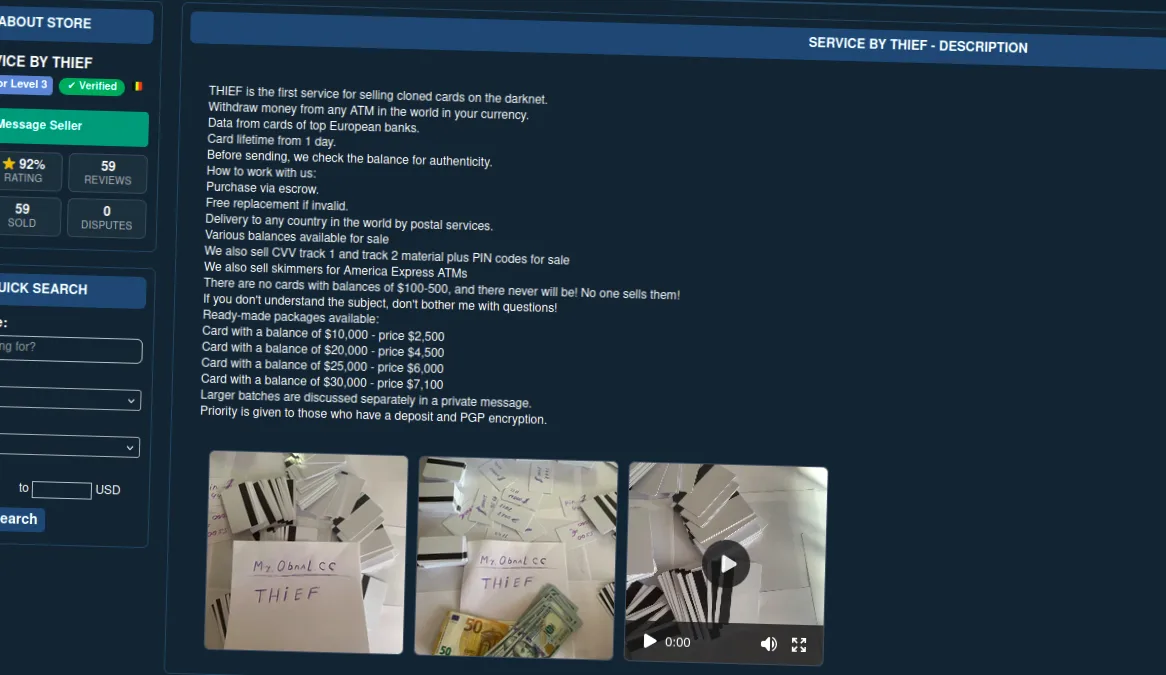
Mark completed his purchase on a marketplace using Monero, chosen precisely for its resistance to tracing. The cards reached him in plain packaging, and the transaction seemed flawless. Online forums dedicated to cloned card operations and skimming techniques frequently stress operational secrecy, yet one crucial factor receives inadequate consideration: cash machines serve not simply as currency dispensers but as thorough documentation systems. Every interaction leaves a trail—timestamps, camera footage, transaction logs—that law enforcement can exploit. Speed and anonymity matter less when the machine itself becomes a witness, recording every detail for later analysis.
2. The Surveillance System Mark Underestimated
Why do contemporary automated teller machines function as comprehensive recording systems rather than simple dispensers? Every unit deployed in the past decade integrates layered monitoring technologies working simultaneously.
Integrated cameras document faces in 1080 high-definition clarity, equipped with infrared capability for dim environments. Many configurations feature an additional concealed lens, mounted from an alternative vantage point and undetectable to users. Each transaction generates a precise digital footprint: withdrawal sum, card identifier, machine location code, and operation timestamp. Geolocation records remain archived within institutional systems, whilst communication logs preserve all network exchanges together with associated metadata.
Mark's visit to the fourth machine in a Tampa Bay district unfolded under full surveillance—the primary lens captured his unobscured profile with complete clarity. No hat, eyewear, or mask interfered with identification. He collected 700 dollars, took his card, and left. The entire sequence lasted twenty-three seconds. Investigators needed nothing beyond that recording.
Offenders routinely believe that anonymity maintained through encrypted platforms carries over to physical locations. The automated teller, however, marks the threshold where digital infractions manifest as observable conduct, and at that crossing, concealment disappears. Anti-skimming safeguards protect legitimate users from data compromise, but once counterfeit cards circulate, the terminal itself generates the evidentiary record. Consumer guidance on detecting skimming focuses on prevention; law enforcement analyses the withdrawal—the instant cash transfers and documentation crystallises. Physical presence transforms abstract data into prosecutable evidence, and no online precaution offsets visible exposure during the transaction itself.
3. Investigation Timeline: From Withdrawal to Arrest
How rapidly do authorities trace dispersed cash machine activity back to one person? Mark's sequence illustrates the tempo of modern financial fraud response.
1 November 2024: Cardholders in Florida, Georgia, and North Carolina discover unauthorised debits. Each contacts their institution, which cancels the compromised card and submits details to a centralised early-warning network.
3 November: Automated monitoring software detects a signature: multiple debits tied to a single set of duplicated credentials, executed across state lines in rapid succession. The system escalates the matter to specialist investigators.
5 November: The U.S. Secret Service assumes control, exercising its authority over financial crime. An agent requests video recordings and transaction records from every machine involved.
8 November: Surveillance footage from one location captures a usable face. Matching this image against Florida Department of Public Safety licence records returns a positive result: Mark T., no criminal history. Separate geographic analysis confirms every debit took place within 40 miles of his home address.
12 November: Authorities obtain judicial permission to examine digital footprints: web activity logs, service provider connection records, and virtual currency accounts. The provider's logs reveal repeated access to anonymising network exit points during the suspected transaction window. His digital currency account traces back to a marketplace profile, confirmed through a subpoena served on the platform where he exchanged fiat currency for Monero.
14 November: A judge authorises entry to his home. Officers recover six unprinted card blanks, magnetic encoding hardware (an MSR unit), a computer showing marketplace browsing records and anonymising software remnants, 3,200 dollars in banknotes, and delivery materials from the original parcel.
15 November: Mark is taken into custody. Under interview, he acknowledges buying the credentials and withdrawing funds using four cards; the other two had ceased functioning because the issuing banks had already disabled them.
The complete arc—from initial victim complaint to formal arrest—required just 15 days. This reflects how tangible artefacts recovered during search operations and electronic audit trails now reinforce one another in prosecuting payment fraud. When investigators secure both physical hardware and server logs pointing to the same individual, defence becomes extremely difficult.
4. The Financial and Legal Consequences
When you weigh what was taken against the court's judgment and the years behind bars, the imbalance becomes unmistakable.
| Attribute | Recorded value |
|---|---|
| Court-ordered monetary obligations (fines plus victim compensation) | USD 22,000 |
| Total currency extracted from machines | USD 4,900 |
| Expense incurred acquiring counterfeit cards | USD 480 |
| Months sentenced to federal custody | 60 months |
| Days elapsed from initial withdrawal until detention | 15 |
| Completed terminal operations | 4 |
| Years under post-incarceration monitoring | 3 years |
Mark netted $4,420 after subtracting the purchase price, yet received 5 years behind bars, a $22,000 obligation, and three years under supervision. Even before factoring in lost freedom, the financial calculation turned negative immediately upon arrest.
5. Why Cryptocurrency Anonymity Failed
Mark selected Monero precisely because of its reputation for shielding user identity, yet law enforcement successfully connected the entire operation to him. Where did the anonymity guarantees break down?
The purchasing process introduced the primary weak point. Mark obtained Monero via a centralised exchange requiring full identity verification—passport scans and facial photographs. Once investigators secured legal authority, the exchange handed over his credentials along with detailed transaction histories. Whilst following Monero through subsequent transfers proved difficult, the original purchase on that particular date for that exact amount became damaging evidence.
The temporal sequence bolstered the case against him. Events including his Monero purchase, the marketplace order, receiving the cards, and cash machine visits all occurred within a two-week window. Such a condensed schedule created circumstantial connections that resisted reasonable explanation.
Physical evidence eliminated all ambiguity. Authorities discovered cards during their search bearing magnetic data that perfectly matched information stolen from identified victims. No cryptocurrency protocol can erase this category of tangible proof. Discussions on carding forums dark web regularly emphasise digital precautions, but physical objects remain beyond the reach of online anonymity tools.
Camera footage provided irrefutable confirmation. A recorded face cannot be retroactively concealed. Even if Mark had executed every other element flawlessly, the ATM camera recordings alone would have placed him at the cash withdrawal sites. Whilst credit card skimming protection focuses on preventing data theft, investigators target the withdrawal stage—the juncture where preserving anonymity becomes effectively unattainable.
The Monero wallet links to an account on the website where the purchase was made through a court order served to the exchange where Mark acquired the cryptocurrency.
6. Operational Failures in Mark's Approach
What concrete missteps converted Mark's supposedly cautious scheme into rapid apprehension? A series of tactical blunders dramatically increased his visibility.
The geographic concentration of withdrawals created an instant red flag. Each of the four machines sat within a 40-mile circle centred on his home address. Financial institutions monitor such spatial clustering because genuine cardholders seldom produce this withdrawal signature when using duplicated cards; anti-fraud algorithms generate alerts within hours of detecting the pattern.
Failure to obscure his appearance removed any investigative complexity. Without masks, sunglasses, or headwear, facial recognition through Department of Public Safety records became trivial. Analysts required only one sharp camera frame to confirm his identity.
Purchasing Monero through a centralised platform tied his legal name to the cryptocurrency he later deployed on the marketplace. Know Your Customer protocols establish indelible audit trails that subpoenas unlock, irrespective of the coin's privacy attributes once transferred. This parallels obstacles explored in cf card cloning discussions—the initial point where physical presence or verified identity enters the chain frequently dictates whether authorities can trace activity backward.
Keeping incriminating materials at his residence handed prosecutors concrete exhibits. Investigators recovered the cloned cards, magnetic stripe reader, and laptop containing browser logs. Electronic traces often persist despite attempts to erase them: Tor Browser generates artefacts, whilst operating system records may reveal usage chronology.
Storing withdrawn currency on the premises supplied further corroboration. The $3,200 confiscated precisely corresponded to bill denominations the ATM had issued—a seemingly trivial match that nonetheless bolstered the state's argument.
The compressed timeframe intensified scrutiny. Completing every withdrawal inside a fortnight prompted immediate anti-fraud mobilisation. Extending the operation across several months might have postponed algorithmic warnings, though surveillance footage would eventually have identified him. Card skimming protector technologies target the initial compromise; once cloned credentials circulate and activate, the cash machine transforms into law enforcement's most dependable informant.
7. Implications for Security Professionals
What can security and fraud-prevention teams learn from Mark's arrest? The investigation offers several operational lessons worth examining.
Automated detection systems form the foundation of modern defence, yet their value is frequently underappreciated. Algorithms analysing transaction patterns, geographic anomalies, and risk scores flagged suspicious activity without any manual intervention. Financial institutions benefit from continued investment in machine-learning tools that spot outliers; in this instance, automated systems escalated the case within 72 hours of the initial victim complaint, demonstrating how speed depends on computational analysis rather than human intuition alone.
Successful investigations require both tangible and intangible evidence working together. ATM surveillance footage provided the decisive proof—a physical artefact captured on camera. Yet that recording would have been meaningless without precise timestamps from the digital ledger telling investigators exactly which frames to review. Merging these two investigative streams creates the backbone of effective casework.
Cryptocurrency anonymity collapses at regulated touchpoints. Mark relied on a coin designed to obscure trails, but his journey had two vulnerable junctures: the regulated exchange where identity verification was mandatory, and the ATM where cash became tangible. These bookends connect the virtual realm to the observable world, and as long as know-your-customer protocols remain in force, true invisibility stays out of reach for ordinary users.
Victim awareness directly influences damage limitation. None of the three cardholders immediately spotted the unauthorised withdrawals. Prompt reporting enables banks to freeze compromised cards before losses mount, so consumer education campaigns yield measurable reductions in total theft and accelerate institutional response times.
For anyone searching on card reader inspection techniques or methods to identify hidden capture devices, remember that prevention targets the data-collection stage, whereas investigations succeed when anonymity breaks down—precisely where the ATM lens records a face.
8. The Sentence and Its Context
During March 2025, Mark T. entered guilty pleas to federal violations: charges of fraud involving payment-device crimes prosecuted under title 18 U.S.C. § 1029, together with money-laundering offences covered by title 18 U.S.C. § 1957. Sentencing took place in the United States District Court, Middle District of Florida, which imposed 60 months of federal incarceration, three years of post-release supervision, and financial penalties amounting to $22,000—comprising both a fine and restitution payments directed to three defrauded victims.
Why does a buyer of cloned cards face such harsh consequences when others design the infrastructure? The judge observed that Mark occupied the final position in the criminal chain—a consumer rather than an architect. End users shoulder the greatest exposure: they appear before security cameras, leave digital footprints at automated tellers, and create transaction trails that investigators follow with straightforward methods. By contrast, platform operators and infrastructure builders remain hidden several layers upstream, where detection proves far more difficult. Discussions across carding forums dark web and cloned cards reddit often stress operational security for purchasers, yet this prosecution demonstrates that buyers inhabit the most precarious role. Those who engineer these systems consistently evade capture, creating an enforcement challenge that authorities resolve less effectively than street-level offences. Purchasers bear the brunt of enforcement while architects persist unseen.
Where Digital Anonymity Meets Physical Reality
Mark's case illustrates the gap between perceived anonymity and actual exposure in financial fraud. Darknet marketplaces and privacy-focused cryptocurrencies create an illusion of invisibility that dissolves the moment physical cash is withdrawn. The ATM, equipped with high-resolution cameras and comprehensive logging, transforms into an evidence collection device that no amount of digital obfuscation can circumvent.
For security professionals, the case demonstrates how modern anti-fraud systems integrate pattern recognition, physical surveillance, and digital forensics into a cohesive investigative framework. The speed of the investigation—15 days from first withdrawal to arrest—reflects both technological capability and inter-agency coordination. Banks, law enforcement, and cryptocurrency exchanges operating under legal compliance create a network where anonymity has defined boundaries.
The broader lesson extends beyond this individual case. As long as digital crime requires physical interaction—whether withdrawing cash, receiving shipments, or appearing on camera—the chain of evidence will contain tangible links. Credit card skimming device detector technology, card skimming protection measures, and consumer education reduce the initial data theft, but once cloned cards enter circulation, the security system's advantage lies at the cash-out point. Mark's five-year sentence serves as a reminder that the final link in the chain carries the greatest personal risk, regardless of how sophisticated the preceding steps may appear.
FAQ
- How quickly can law enforcement identify someone using cloned cards at ATMs?
In Mark's case, investigators identified him within eight days of the first victim complaint through ATM surveillance footage cross-referenced with driver's licence databases. The entire process from first withdrawal to arrest took 15 days, demonstrating how rapidly anti-fraud systems and inter-agency coordination operate.
- Does using Monero or other privacy cryptocurrencies protect buyers on darknet marketplaces?
Monero provides transaction-level privacy, but the entry point—purchasing Monero through a KYC-compliant exchange—creates a permanent record linking legal identity to the cryptocurrency. Court orders can compel exchanges to provide this information, effectively breaking the anonymity chain at its origin.
- What evidence do ATMs collect beyond video footage?
Modern ATMs record transaction logs with timestamp accuracy, card numbers, withdrawal amounts, ATM identifiers, geolocation coordinates, and network metadata from processor requests. This data, combined with high-resolution video (often 1080p with infrared capability), creates a comprehensive evidence package that links specific individuals to specific transactions.
- Why do anti-fraud systems detect cloned card usage so quickly?
Machine learning models analyse patterns including geographic clustering, temporal concentration of withdrawals, and deviations from normal cardholder behaviour. When multiple cards from the same compromised batch are used within a short timeframe and limited geographic area, automated systems flag the activity within hours, triggering investigation protocols before significant additional damage occurs.
Sources
- Police make arrest in string of local credit/debit card abuse cases
- CCTV: Police investigate ATM withdrawals at Peakhurst and Roselands | St George & Sutherland Shire Leader | St George, NSW
- How Eye Witness Exposed an ATM Fraud Network | Case Study
- Two Romanian Nationals Arrested For Cloning ATM Cards In Mumbai