I Nearly Bought a Passport on the Dark Web: Here's What Stopped Me
A registered passport obtained through corrupt channels costs at least $30,000 on the black market. Listings offering to buy a passport online for $500–$2,000 are scams without exception.
Published: | Updated: November 23, 2026 | By: Derek Whitman | 8 min read
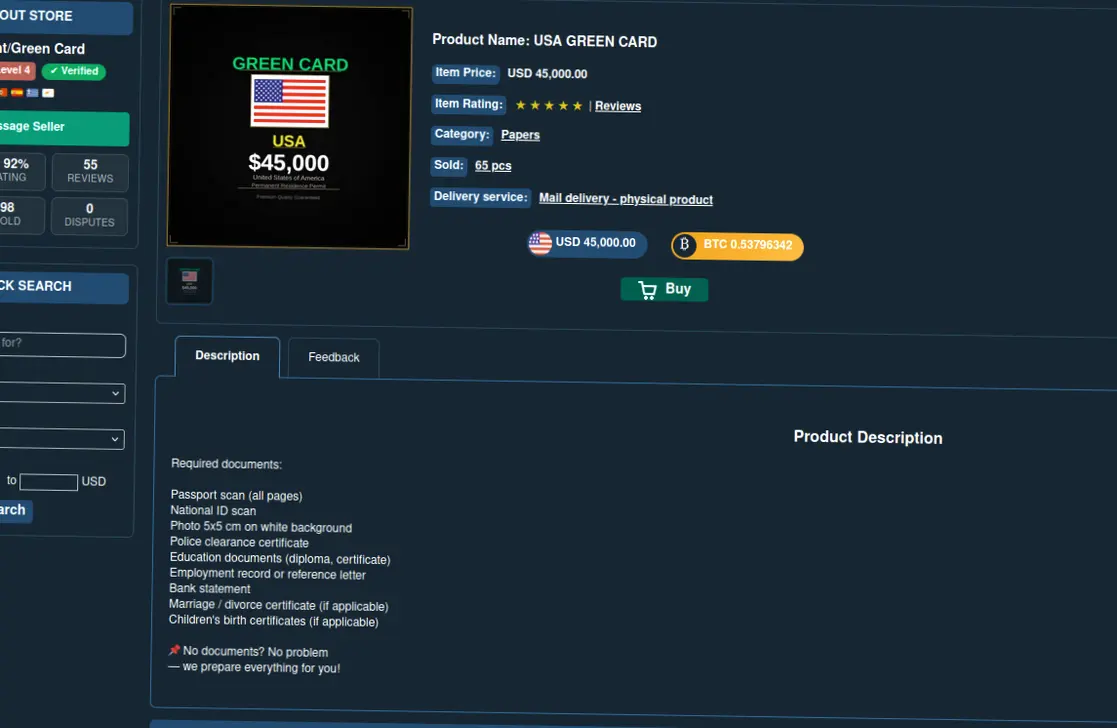
The proposition appears simple: purchase a second passport, acquire a green card for sale, begin a new life under a different identity. Enter the correct search terms, locate a darknet marketplace, and within moments you encounter numerous sellers offering passports, green cards, driving licences — all claimed to be authentic, all supposedly entered into official registries. Costs vary from several hundred to a few thousand dollars. Customer feedback commends the workmanship. Sellers provide authenticity assurances.
Every offer is a fraud. The financial reality alone renders it impossible. Examine the true figures here: a legitimate US green card secured via official bribery demands $30,000 to $60,000. A US passport requires $35,000 to $80,000. European passports begin at $25,000. These amounts reflect genuine expenses: corrupting civil servants, penetrating secure printing facilities, inserting records into linked governmental databases, and mitigating exposure at each phase. A vendor claiming to sell an authentic passport for $800 isn't merely questionable — the arithmetic simply collapses.
Advertised rates versus actual costs expose the deception. Whether you seek to buy a diplomatic passport, buy a citizenship passport, buy a green card online, or even buy a novelty passport, darknet markets thrive on false promises. Grasping why the figures contradict themselves protects you from severe financial harm.
You can see the actual price here: a legitimate US green card obtained through corruption costs $30,000 to $60,000.
What Makes a Legitimate Document Cost Tens of Thousands
What drives the price of an illegally obtained genuine passport or residence permit into five-figure territory? The answer lies not in printing technology but in the layered infrastructure of corruption, technical penetration, and operational risk that surrounds every stage of production.
The chain begins with database insertion. A compromised employee within a passport agency or immigration office must create an authentic record in the national registry. Facing potential prison sentences measured in years, these insiders demand compensation that typically begins at tens of thousands of dollars. Modern identity documents carry embedded biometric information—fingerprints, facial recognition data, iris patterns—that must exist in the system before any physical card or booklet is printed. Reaching the equipment and secure databases to plant this information requires either privileged internal access or advanced technical compromise, both of which carry substantial costs.
Physical production introduces another barrier. Blank passport booklets and residence card stock originate from heavily guarded government printing facilities, including establishments like the Government Publishing Office in the United States. Every blank is accounted for. Extracting these materials without detection demands either outright theft or the complicity of facility personnel, each avenue requiring significant financial outlay. After production, the document must populate interconnected systems: immigration records, border control platforms, law enforcement networks. Each integration point represents a distinct vulnerability, a separate bribe, and an additional exposure risk.
Operational expenses compound the total. Secure transport, compensation for intermediaries who shield themselves against discovery, contingency payments to officials when complications emerge—each stage inflates the final figure. After passing through three to five handlers before reaching the purchaser, the accumulated cost becomes clear. A United States green card or passport commands $30,000 to $80,000 through these networks. European passports range from $25,000 to $50,000. Even in jurisdictions with less robust database security, prices begin at $5,000 to $15,000. Any online advertisement claiming to sell a genuine passport for $500 bears no relation to these economic realities.
Darknet Listings vs. Black Market Reality
Why do underground forum advertisements quote sums dramatically lower than what procuring legitimate credentials through bribery actually demands? The answer lies in distinguishing fake replicas from officially registered papers inserted into state systems. Consider these figures:
| Official credential | Illicit forum advertisement | Verified corrupt-channel expense |
|---|---|---|
| Lawful permanent residence certificate (United States) | $800–$2,000 | $30,000–$60,000 |
| Member-state travel booklet (Germany, France) | $600–$2,000 | $25,000–$50,000 |
| Federal travel booklet (United States) | $500–$1,500 | $35,000–$80,000 |
| Travel booklet (lower-income state) | $300–$1,000 | $5,000–$20,000 |
| State motor-vehicle authorization (United States) | $200–$800 | $5,000–$15,000 |
| Social Security Number identifier | $50–$300 | $1,000–$5,000 (stolen, not legal) |
These price differences do not represent competitive pricing or vendor generosity. Offerings at advertised rates consistently deliver crude imitations created with consumer software, blank templates unsupported by any official registry, or outright scams. A fake produced on standard printers fails instantly when subjected to ultraviolet examination, microprint analysis, or database queries. Online counterfeiters lack the capacity to replicate embedded security elements: holographic layers, laser-etched features, RFID technology, polymer substrates.
Sellers understand these constraints perfectly. Their business model relies on exploiting desperation and naivety. Promotional materials describing premium-quality forgeries or novelty items exist solely to extract payment before purchasers discover the merchandise is worthless. Even when a counterfeit appears plausible to casual observation, it disintegrates the moment an official applies standard verification protocols. The pricing disparity reveals everything: were vendors capable of producing credentials that withstand official scrutiny for $800, they would charge $20,000 and still significantly undercut corrupt insiders. They do not because such production remains impossible.
Authentic credentials demand database registration, biometric encoding, and specialised materials inaccessible through ordinary supply chains. Fraudulent alternatives bypass none of these critical requirements. The moment an inspector scans the embedded chip, accesses the official database, or examines the substrate under magnification, the forgery becomes apparent. The substantial price gap is not proof of opportunity—it confirms that delivered items will fail precisely when verification matters most.
Recognising the Scam Before You Pay
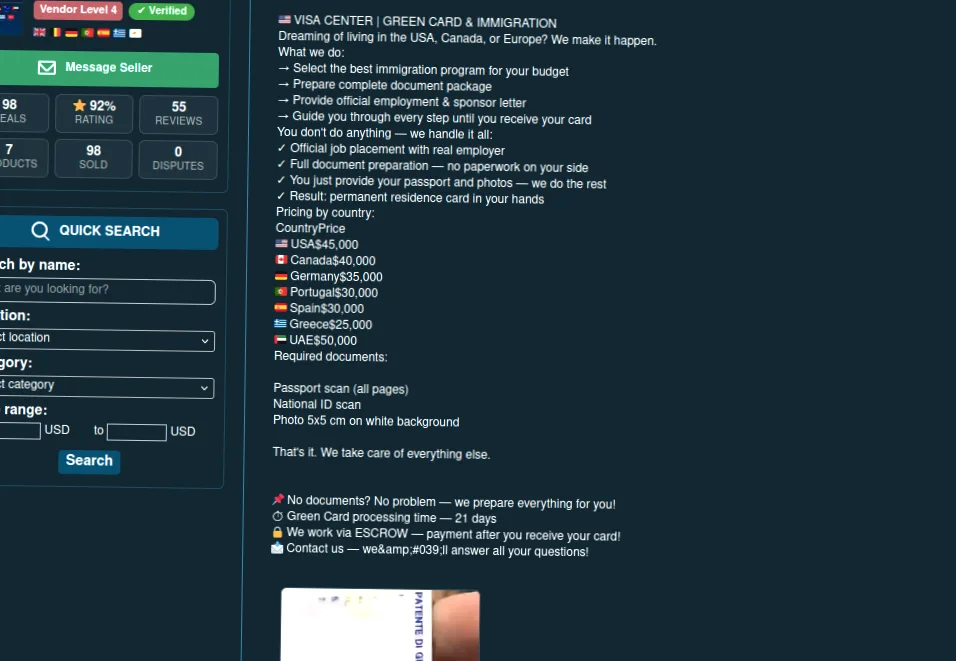
How can you identify a fraudulent listing before transferring funds? The red flags remain uniform regardless of which vendor or platform you examine.
Cost serves as the clearest signal. Any proposal suggesting you can acquire diplomatic credentials, citizenship documentation, or permanent residency cards for under $10,000 represents fraud. Authentic documents procured via corrupt networks never surface on open marketplaces at accessible rates. These transactions occur through confidential channels involving substantial deposits, in-person verification, and demonstrable proof of insider connections. A seller promoting services on a darknet forum with automated payment processing holds no genuine government ties.
User testimonials and ratings prove trivially easy to manufacture. Fraudsters establish multiple accounts, compose favourable reviews, and artificially inflate their own reputation scores. A platform displaying numerous perfect ratings means little when the entire system exists to facilitate theft. Escrow mechanisms provide minimal security; most sellers vanish after funds clear, whilst marketplace operators frequently lack both resources and motivation to pursue reimbursements.
The wording within advertisements itself exposes underlying intentions. Claims such as "entered into official registries," "survives all verification procedures," "identical to authentic versions" constitute promotional language rather than technical specifications. A seller with actual access to governmental systems would never advertise openly. Such individuals operate exclusively through trusted referrals, require considerable advance payments, and restrict their clientele to reduce risk exposure. A vendor proposing instant delivery of permanent residency documentation through anonymous channels is peddling illusion.
This principle applies whether you encounter advertisements for identity documents, residency permits, or citizenship papers through encrypted communication platforms. The operational framework necessary to generate legitimate credentials fundamentally conflicts with the pricing models and public accessibility characteristic of darknet marketplaces. The seller is either distributing inferior forgeries or providing nothing whatsoever.
The Price Gap Reveals the Scam
The darknet exploits the distance between wishful thinking and reality. When a vendor advertises a genuine passport available for $800, they are preying on urgency and naivety, selling a fantasy that cannot exist at that price. The logistical complexity, bribery networks, and criminal risk involved in creating a document capable of passing official verification make such pricing impossible for legitimate black market operations.
Authentic identity documents acquired through illicit channels command $30,000 to $80,000 for US passports and green cards, whilst papers from other nations range from $5,000 to $50,000. Any offer beneath these figures represents either a worthless forgery destined to fail at first inspection or an outright fraud where payment vanishes along with the seller. The mathematics leave no room for doubt, and those who ignore them face harsh outcomes: stolen funds, criminal liability, and potential detention when presenting falsified credentials at borders.
Grasping the deception means recognising genuine cost structures. No marketplace vendor, regardless of how professional their photographs appear or how glowing their testimonials read, can supply an officially registered passport for the cost of consumer electronics. The financial reality makes it impossible, and every such claim is fabricated nonsense designed solely to separate victims from their money.
Sources