How Derek H. Tried to Deposit Fake $100 Bills Through an ATM
A Denver man's attempt to launder counterfeit $100 bills through ATM deposits collapsed when banks flagged suspicious transactions, leading to his arrest by federal agents.
Published: | Updated: November 23, 2026 | By: Derek Whitman | 5 min read
Could automated banking terminals actually process fraudulent currency without detection? Derek H., a 29-year-old Denver resident, thought the technology would work in his favour. His approach seemed simple enough: purchase convincing replicas through underground channels, deposit them via cash-accepting machines, then extract the credited balance as legitimate funds. The entire operation depended on automated scanners missing defects that trained bank employees would catch during manual inspection.
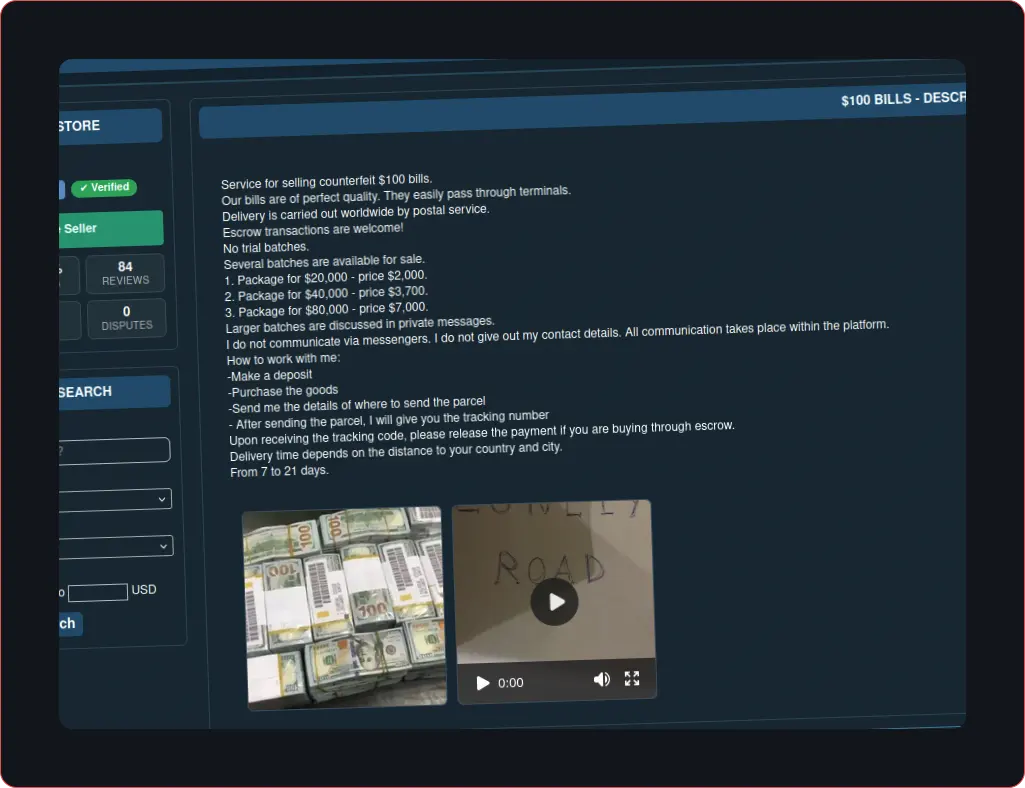
At the beginning of January 2025, Derek sent digital currency valued at $1,200 to an operator on an encrypted marketplace. What arrived was described as 40 counterfeit notes bearing the $100 denomination from the 2009 series, promoted as superdollar-quality forgeries featuring working security elements—ultraviolet markers, magnetic strips, and embedded watermarks. According to the vendor's advertisement, these reproductions would pass ordinary visual checks without raising suspicion.
His method deliberately avoided any personal interaction. Instead of trying to spend the notes at shops where employees might examine bills closely, Derek chose self-service deposit terminals. Such devices scan inserted currency, confirm denominations, and update account totals without human oversight—a procedure that appeared less stringent than counter verification. The attraction for anyone browsing underground marketplaces lies in eliminating direct scrutiny entirely, relying instead on machines to validate what humans might reject.
How the Deposit Scheme Unravelled
Why did the first two ATMs accept Derek's deposits without incident? Cash-handling machines employ optical sensors and basic magnetic stripe readers, checking for standard security markers present on genuine notes. The counterfeit currency Derek purchased replicated these features sufficiently to pass initial automated checks—$800 in fake money dollar bills successfully entered his account. The technology worked as designed, but only at the first layer of verification.
The third terminal rejected one bill outright, returning it with a generic error message. This happens when sensor readings fall outside acceptable parameters, though the machine provides no detailed explanation. A fourth ATM accepted the deposit but tagged it for manual review, a flag triggered by inconsistencies detected during scanning. Banks maintain secondary verification protocols precisely for such cases, routing suspicious deposits to fraud analysts who examine transaction patterns and physical currency samples.
Once the review commenced, investigators compared Derek's deposited bills against known characteristics of fake counterfeit money circulating in the region. They discovered anomalies in paper texture, ink composition, and microprinting quality that automated systems had missed. The bank froze his account within hours, and three weeks later the Secret Service—responsible for currency crime enforcement in the United States—took Derek into custody. The same counterfeit $20 dollar bills and other denominations circulate through similar channels, with buyers seeking to buy fake dollars or purchase realistic fake money australia-style notes through dark web vendors.
The Economics and Detection of Fake Currency
How do darknet sellers price their fraudulent currency? Hidden marketplace vendors generally discount high-quality reproductions by 50 to 60 percent of face value, which meant Derek spent approximately 30 cents for each purported dollar of forged notes. Whether customers seek batches of replica 20 or 100 denomination notes, the pricing follows comparable patterns, with volume orders receiving deeper reductions. This business model depends entirely on purchasers believing they can successfully pass the forged currency that darknet suppliers provide into mainstream commerce.
Financial institutions deploy multiple defensive layers against such schemes. Automated machines serve as initial checkpoints, detecting obvious flaws immediately during transactions. Follow-up examination involves trained specialists who recognise subtle irregularities—serial number spacing inconsistencies, improper ink lustre, or misaligned watermarks. Even advanced forgeries claiming elite status crumble under professional analysis, especially when several notes from identical production runs display matching defects. Banks additionally monitor deposit behaviour, raising alerts when accounts suddenly show numerous cash infusions lacking corresponding business activity.
Prosecution reaches far beyond simple account termination. Federal authorities pursue counterfeit currency offences aggressively, with possession alone potentially resulting in imprisonment whether the defendant printed the bills or merely obtained them. Derek's situation demonstrates how purchasing fraudulent currency creates enduring criminal exposure, even when the original transaction occurred anonymously using cryptocurrency through digital marketplaces. The legal risk persists regardless of how carefully buyers attempt to obscure their involvement in these underground economies.
Why Counterfeit Schemes Fail
Derek's case illustrates precisely how these laundering operations crumble regardless of early wins. Automated machines flag sufficient forgeries to prompt manual inspection, and when currency experts assess the notes, even sophisticated fakes betray themselves. Provisional account credits mislead perpetrators into believing they've succeeded, yet financial institutions routinely void fraudulent transactions and alert federal agencies.
Darknet vendors promoting counterfeit products—whether marketed for film use or overseas buyers—face an insurmountable obstacle: contemporary banknotes contain protective elements requiring state-level technology to duplicate convincingly. Sellers advertise UV-reactive threads and magnetic ink, but these imitations crumble under the layered authentication protocols banks deploy. Anyone weighing such approaches should recognise the pattern: discovery, federal charges, and permanent criminal histories that far exceed any fleeting monetary benefit.
Federal investigators traced Derek's cryptocurrency payment to the website where the purchase was made, though such marketplaces frequently relocate to evade law enforcement.
FAQ
- Why did some ATMs accept the counterfeit bills initially?
Cash-accepting terminals use basic optical and magnetic sensors that check for standard security features. High-quality forgeries replicate enough markers to pass these automated first-layer checks, but secondary bank reviews detect subtle flaws in paper quality, ink composition, and microprinting that machines miss.
- What typically triggers a bank to flag cash deposits for review?
Inconsistencies detected during automated scanning, unusual deposit patterns for the account holder, or multiple cash transactions without corresponding business activity all prompt manual verification. Banks route flagged deposits to fraud specialists who examine both the physical currency and transaction history.
- How much do counterfeit bills cost on darknet markets?
Vendors generally price high-quality forgeries at 50–60% below face value, so a $100 counterfeit note might sell for $30–50 in cryptocurrency. Bulk purchases receive discounts, though the pricing reflects the near-certainty that many bills will be detected before successful use.
- What legal penalties apply to possessing counterfeit currency?
Federal law treats possession of fake currency as a serious offence regardless of manufacturing involvement. Convictions carry potential prison sentences, and prosecutors pursue cases even when defendants claim ignorance of the bills' fraudulent nature, as demonstrated by Derek's arrest three weeks after account suspension.
Sources